

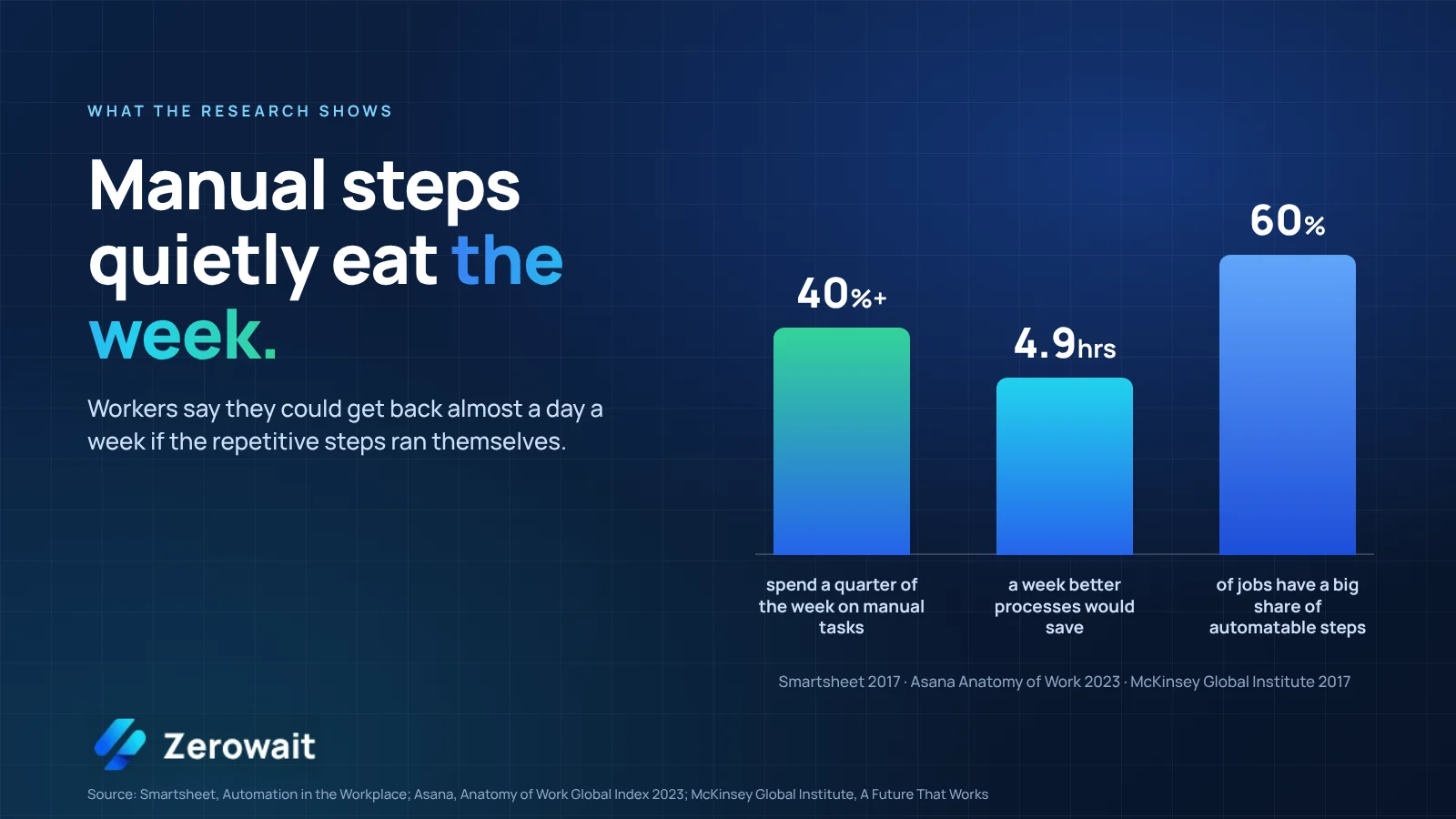
If you have read anything about automating business processes, you have probably seen three numbers: over 40% of workers, 4.9 hours a week, and 60% of jobs. They get quoted in sales decks and blog posts, often without a source and sometimes with the meaning stretched. This article sets out where each figure comes from, what the researchers actually measured, and what you can fairly take from them.
The short version
A large share of an ordinary working week goes on steps that do not need judgement: re-entering details, chasing approvals, moving information from one place to another, and checking whether something has been done. Workers know it, say so when asked, and estimate they could get back the best part of a day a week if those steps ran themselves.
Over 40%: how much of the week is repetitive
In 2017, the work-management software company Smartsheet surveyed office workers for a report called "Automation in the Workplace". It asked how much of their week went on manual, repetitive tasks and which tasks they would most like to see automated.
What they found:
- Over 40% of workers spend at least a quarter of their working week on manual, repetitive tasks
- Email, data collection and data entry take up the most time
- The tasks workers most want automated are data collection (55%), approvals (36%) and updates (32%)
- Nearly 60% estimate they could save six or more hours a week if the repetitive parts of their job were automated
Those six hours are close to a full working day. Asked what they would do with the time, 72% said more valuable work for the business, and 78% said the more interesting and rewarding parts of their own job.
4.9 hours: what workers say they could get back
Asana, another work-management software company, has run a yearly "Anatomy of Work" survey since 2019. The 2023 edition was run by the research firm GlobalWebIndex in November 2022 and covered 9,615 knowledge workers in six countries, including Australia.
Its headline finding is that workers spend 58% of their day on what the report calls "work about work": coordinating, chasing, switching between apps and searching for information, rather than the skilled work they were hired for.
On the question of process, knowledge workers estimated they could save 4.9 hours a week with improved processes. Over a year, the report notes, that adds up to more than six working weeks per person.
Two smaller findings explain where the time goes:
- Workers lose 2.8 hours a week to unnecessary meetings, and senior leaders 3.6 hours
- The average knowledge worker uses 8.8 different apps, and those using 16 or more are far more likely to miss messages and actions
Free Initial Appointment
See how this applies to your business.
One conversation about the work taking up your team’s time. No preparation needed.
- Usually 30 minutes to an hour
- No obligation
60%: how much of the work could run itself
The 60% figure comes from a different kind of study. In 2017 the McKinsey Global Institute published "A Future That Works", which analysed more than 2,000 work activities across about 800 occupations to work out which could be done with technology that already existed.
Its findings:
- About 60% of all occupations have at least 30% of their activities that could be automated
- Fewer than 5% of occupations could be automated entirely
- Almost half of all the activities people are paid to do worldwide have the technical potential to be automated
The activities with the highest potential were predictable physical work (81%), processing data (69%) and collecting data (64%). Processing and collecting data is exactly the work that fills an ordinary admin, finance or operations role.
What these studies do not tell you
These numbers are useful, but they are often pushed further than they should be. Before you lean on them, it is worth knowing their limits.
- Two of the three come from software vendors. Smartsheet and Asana both sell tools that reduce manual work. That does not make the surveys wrong, but it is worth knowing who asked the questions.
- They are self-reported. The 40% and 4.9 hours figures are what workers estimated about their own week, not what a stopwatch measured. People tend to remember the frustrating parts of a job more than the smooth parts.
- They are averages across many kinds of work. A warehouse supervisor, a bookkeeper and a marketing manager will each be a long way from the average.
- McKinsey measured what is technically possible, not what is sensible. An activity can be automatable and still not worth automating, because it is rare, or because a person doing it catches things a system would miss.
- The data is getting older. The McKinsey and Smartsheet work is from 2017. Tools have improved since, but so has the volume of email, apps and notifications people deal with.
What makes the findings hard to ignore is that they agree. Different companies, different years, different methods, and the answer is the same: a large part of the working week is spent on work that does not need a person, and the people doing it know.
What this means for your business
You do not need to automate half your business to act on this. The gains sit in a handful of processes that everyone recognises: the ones that involve re-typing, chasing or checking.
A few practical steps:
- Ask your team which tasks they would hand over first. The Smartsheet survey found people are clear about this. Data collection, approvals and status updates came top, and your team's list will probably look similar.
- Count the hand-offs, not the hours. Every time a job sheet, invoice or request moves from one person or system to another by hand, something can wait or go missing. Those hand-offs are where process automation pays off.
- Start with one process end to end. A single process that runs reliably, with clear owners and reminders, proves the approach and makes the next one easier.
- Keep decisions with people. The research says the routine steps are automatable. Approvals, exceptions and anything unusual should still land with someone who can use their judgement.
- Measure before and after. Time one process now, so you can show what changed.
Sources
- Smartsheet (2017). "Automation in the Workplace". Read the summary on smartsheet.com
- Asana (2023). "Anatomy of Work Global Index 2023". Survey of 9,615 knowledge workers by GlobalWebIndex, November 2022. Read the announcement on businesswire.com
- McKinsey Global Institute (2017). "A Future That Works: Automation, Employment, and Productivity". Read the in-brief summary on mckinsey.com (PDF)
By Zerowait. Examples are illustrations, not client work.
How Zerowait helps with this
The practical side of business process automation.
Approval Workflows
Requests routed to the right person, with reminders, so nothing waits in an inbox.
Data Entry & Transfer
Details captured once and passed between systems, instead of being retyped.
Customer & Staff Onboarding
Every new customer or new start set up the same way, every time.